Who would I be without my oligodendroglioma?

Although I cannot let my disease define who I am, I must acknowledge how the disease becomes intertwined with my identity.

My brain cancer slowly grows and invades surrounding healthy tissues. The healthy tissues protect and bind nerve cells like glue by supporting a flow of electrical signals in the brain, and the glioma cells can clump and form a tumor. I know have two tumors: one located in my left parietal lobe which has impact my language center, and the second is in my corpus callosum which could impact the coordination between the two hemispheres.

To extend my life, I’ve endured several treatments and surgeries to remove and kill the malignant tumors. The aggressive treatments like radiation have caused chronic illnesses such as necrosis, nerve pain, chronic headaches and fatigue. During a past neuro-oncologist visit that sticks with me, we had a conversation about how radiation can age the healthy cells and slow the process of forming thoughts and comprehension.

Since I’ve had two radiation treatments in the same region within four years and along with the brain hemorrhage, I can feel like a much older human being from the neuro-fatigue. Sometimes, I imagine a traffic jam where vehicles are annoyingly honking out of frustration during construction or an accident: “pump the breaks and slow down; more time is needed to create a space for the traffic to flow.” Then how old I may feel can fluctuate considering I am young enough to recover which becomes a matter of pacing and patience. Eventually, I do have moments to feel rejuvenated once again.

Similarly, although my infusions (Avastin) to alleviate the swelling (edema) from the radiation injury has been effective, the treatment is not a permanent solution and has its own side effects: mostly additional fatigue along with body and joint aches. However, beforehand, there had to be a confirmation as to whether there are dead tissues becoming a nodule which can appear like a tumor or whether there is a recurrence with the true disease. For this, there is a perfusion MRI which measures the blood flow through tissues to determine which one to treat.

And fortunately, since my GammaTile operation back in 2021, the true disease has been stable in my left parietal lobe. I chose the aggressive approach with GammaTile because I had gotten sick from taking any chemotherapy treatment. The radiation has done its job; perhaps too well by overdoing it with the necrosis, but the risk gained more time to deter another chemotherapy treatment which are limited for me.

I’m currently on lomustine and procarbazine to stabilize my corpus callosum’s tumor. There are six cycles for each six weeks. I’m on cycle five and finished my lomustine last Monday. I’ll start two weeks of procarbazine on this coming Monday. And counting down, if all goes well, I might be able to complete the treatment in September.

The chemotherapy treatments can wreck my stomach, and with procarbazine, I also have to be mindful with tyramine because I can get hives if I consume too much (which I have; whoops). And there seems to be a cumulative properties for the chemo where this last lomustine hit me hard with the nausea and fatigue. Still, I managed to recover well enough to enjoy spending time with family throughout the week and weekend: Top Golf, walks and meals, and even enjoying an outside concert. This is where life continues to surprise me when I’m willing to surrender myself into all of life which is a practice in itself.

There are these paradoxes that I often need to address during recovery and healing. The logical part of me wants to jump into the treatment planning: “Tell me what I gotta do against the disease; I’ll do it. I want to live, after all.” Then there’s the emotional component where I can feel like I’m drowning in despair: “How can I move forward when everything feels miserably overwhelming?” And this is when the logic becomes illogical yet still seems reasonable: “I’ve harmed myself once again” or “I feel like I’m dying.” Or in other words, I can get lost in the grieving through existential crises or dread: “I cannot keep doing this to myself. There is too much pain.”

One approach is grounding myself into quality of life. Again, there is the disease, and there are the chronic illnesses. For me, I need to transition further towards giving more healing for the chronic illnesses. There is only so much that my body, mind, and soul can take until I break. The challenging part is bridging the three by building habitual behaviors by leading towards a sense of wholeness. We have this capability by training our self-awareness through practices that connect between our inner and outer worlds with rituals and routines. By that, giving space and time to reflect on oneself like journaling, then interacting outside intentionally which creates impacts for oneself and others like enjoying a concert.

Or what people often say, “Gotta take it day by day.” And the complicated part is: “what do you do about your day? And how are days leading you? How do you feel overall?”

This is where I’ll bring in, “everything happens for a reason.” It’s another platitude.

Perhaps checking in, emotionally, “how do you feel when someone gives you a platitude?” It’s a moment to self-reflect and ease into one’s self-awareness. “There’s no fucking reason for anyone to be given a brain tumor.” Which is a moment to deconstruct a platitude and introspect: “where is your anger right now?”

Because fuck this disease. However, there are emotional reasons, and there are logical reasons. And we do not have access to all reasons. I will never know the reason for my brain cancer. We can name it: “I have an anaplastic oligodendroglioma.” But we do not understand what causes it yet. However, we can give reasons from what we do know: “Living with brain cancer has shaped my identity.”

By that, “everything happens for a reason,” then gives a feeling of “surrendering into the unknown.” Perhaps I’ll learn in time or maybe I never will. The importance is acknowledging the meaning as we are meaning and patter seeking species.

This is where it gets especially tricky when conversation: tone. Again, that can impact what we’re feeling in the moment from a platitude. Is someone giving an impression to come in closer? Or are they brushing something off because they’d rather not get closer? Therefore, it’s a moment to check-in and ask oneself, “how am I feeling right now when someone has given me this platitude?”

With that in mind, for me at least, I’ve been dipping deeper into soul work: “giving into the suffering for a certain amount of time.” That way, creating and giving space to allow myself to feel everything for a period of time which is in the inner world. Afterwards, getting back to the outer world by perhaps simply being outside and listening to the birds.

Because when I do reflect from how far I’ve grown from this disease and the chronic illnesses, I find that my resilience comes through as strength and connects through others. Both have shaped me as to who I’ve become now. And the more that I work towards this, the more I can give myself back to the world.

This feeling of softness internally where others seem to feel more comfortable with me and sharing their plights by remaining open with the heaviness and still feeling light. That while the disease comes across shocking and horrific, there is something beautiful in how we strive forward despite it all. This is beyond brain cancer or any disease. It’s a reminder that we’re still somehow able to live how we are for the time that’s given.

Who would I be without my oligodendroglioma?

I wouldn’t be me. All of this has pushed me to limits that I never would had expected, and I continue to be challenged. Sometimes it’s a matter of how to direct this energy with a sense of purpose by aligning intentions and impacts. And look at how many people are impacted by this disease and similarly strive forward to fight against the disease: researchers, non-profits, fundraisers, and so much more. This community continues to impress me, especially the fellow survivors and care partners who learn how to adapt with life.

Although I do not believe that there will be a cure in my lifetime, I do know that there are promising treatments towards stalling the growth while continuing to better understand the disease: inhibiters for gliomas seem promising with minimal risks.

There is hope even if we cannot find it. Hope is always there. It can be a matter of finding the willingness to dip deeper into the heaviness, learning how to endure, and finding the hope from a different perspective. I do not have hope for a cure. I have hope to truly feel alive like the air around me and to feel grounded once again in life; no matter what happens.
Recovering From Death

Let’s touch on death. Or at least, maybe death within life? I’m one who tends to seek meaning and metaphors in life.

With death, metaphorically, I imagine a snake shedding its skin: change. Literally, human beings also shed their skin’s dead cells. Connecting both, we must embrace change lest we become stagnant, or worse, rotten.

Change is painful. We hold onto parts of ourselves that we believe we need. We do it automatically. If you’re well, you never have to think about it. However, if you’re in a shock or coping from trauma, there are mechanisms in play to protect oneself which create barriers for growth. One has to be willing for change to happen and given support from others, especially professionals.

For me, I was close to death when I had my brain hemorrhage. For about a month, I felt like all this weight had been lifted from me with a feeling of bliss. Then my headaches had gotten extremely worse where I needed to be on steroids on and off. All the heaviness was back and worse. I had to grapple those swings, and I still can have that struggle during treatments.

For the swings, I imagine and ask, “where is my pendulum?” Am I swinging high, or am I swinging low? This involves my own energy output, but also how I can get affected from the treatments. Keeping the idea, I want to keep the momentum; otherwise, I feel stuck. I have to move with the swings but to make sure that I’m mindful with my choices and the consequences. Which can be absolutely exhausting. However, I have to make sure that I am pacing myself. “It’s a marathon, not a sprint.”

Yeah, well, I like to sprint sometimes. Again, that’s the choice and the consequence. It’s worth it sometimes.

A major impact from the acquired injury is that I cannot read well. An attempt to read exhausts my energy and brings in the headaches. To adapt, I’ve learned how to build connections with text-to-speech applications. Strange at first for free ones that feel robotic, but over time, my ideas can flow through me more easily. I’m also given more control by the speed of speech and can repeat until I understand the meaning. Along with that, I can struggle getting to my word: tip at the brain. I often can’t type it out correctly even if I can say it out loud.

My main tools are enabling dictation on my iPhone, NaturalReader, a notes app, and Google. That way, I can now read any text by speaking it out to me, or I can speak out any text if I’m struggling to type it out. And if I’m really struggling to get the word, Google has the best search results for what I’ve intended.

I’m doing these apps now while writing this blog post. On my own, I don’t know how long it would take. I could get there. Eventually. But how could I live like that? I’d be on a much higher difficulty to live and communicate socially. That’s the power of technology. There is a lot of assistance that’s available from any impact to the brain. For me, it’s been a matter of the commitment with the swings.

Similarly, my brain needs exposure in dynamic environments while being aware of how I can struggle with overstimulation and oversensitivity. For the first couple years, I would be easily overstimulated and would have to lie down in a quiet place for a long nap. Through exposure overtime and adding assistance with a earplug to dampen and filter the noise, I’ve found myself opening up more to social environments.

Today, I was able to walk my dog, Gambit, to the dog park with some chitchats, then I enjoyed a movie at the theater. And I’m still somehow writing this blog post. Stopping for a moment checking in on my progress over the years, I’ve made leaps and bounds. The brain is fragile, but more importantly, it’s resilient. Bringing back the pendulums, perhaps imagine the swings like swing set. Something more playful sometimes.

All that to say, the losses are the deaths where we can give room for more growth. We have to ease into the losses and feel them, truthfully. That’s the grief. And through the grief, we create spaces to regenerate one’s self through the healing. And we don’t need to do it alone. We grow together.

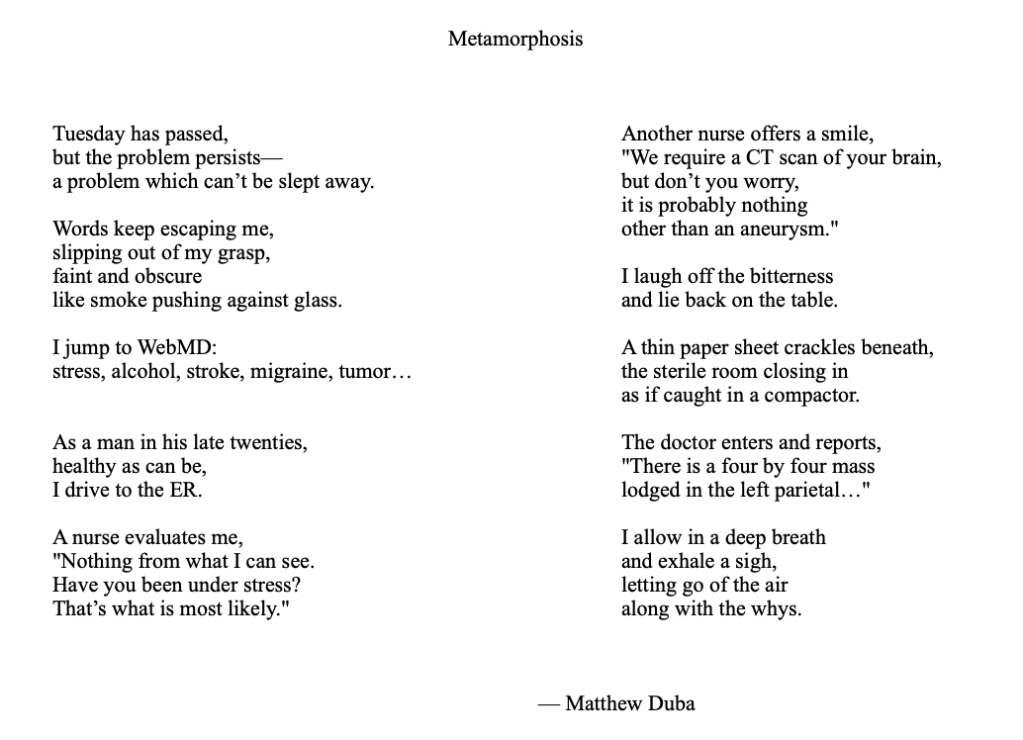
Sharing a little more, this is a poem that I wrote during a creative writing class right before the pandemic and my brain hemorrhage.

An attempt to open up with my imagination and creativity can be incredibly painful. I lost my sense of imagination after the brain injury. I didn’t know if I’d ever get a sense of creativity back. However, that’s also going well with the recovery where it’s becoming more cathartic to push forward. I’m trying right now. Here’s a draft for fiction:

“The Boy Who Would”

Chapter One

Lost

Once upon a time, a boy fell in love with the sky. He quickly learned how to fly and touch the clouds.

In time, he became compelled to fly beyond the sky to escape his worries. He flew too high and too fast. He blacked out, spinning and falling into an abyss. When he woke, there was nothing for him but darkness; there was no light in sight. He crawled into a ball and cried until he could not.

A whisper of a breeze broke his slumber with a drip. He stood up, dizzy and foggy. He took one step forward, then another drip, drip. He followed the droplets, then lifted his hand to brush his fingers across the mist nearby.

There was an echo from another drip, drip, drip. Step by step, he was led to a stone wall. He ran the tips of his fingers along a curved statue. A warmth shined into his heart, quivering his bones.

He opened his eyes and the warmth dissipated. Ominous shadows lurked around him. He squeezed his eyes closed and clenched his teeth. He open palmed his hands against the marble, screaming out, “I’m not afraid.”

A strange voice bellowed, “You should be.”

“W-w-who are you?”

“More importantly, who are you?”

“I… I don’t remember.”

“That happens here.”

“Where am I?”

“Everywhere, nowhere, and in between.”

“I don’t understand.”

“You will.”

“I want to get back home.”

Silence. He crawled into a ball and cried and cried until he could not.

A Catalyst for a Resurrection

Although I shut down back in 2017, I am opening this blog to once again share my story with the hope that it may resonate with someone.

Since then, I’ve gone through several more operations and treatments. From each treatment, surgery, and medication, there are been impacts to my body, mind, and soul which fractures a sense of self. It’s traumatic each time. Even though I may be the one making the choice with my team, my body does not.

Through resilience, I can give myself grace, patience, and healing over time. We can adapt with what we’re given. And for me, I’m leaning deeper into the suffering to learn from life through the lens of my curiosity when I can. There are limitations, walls, and barriers. Some may had been created for me to survive but now need to be broken as they are no longer helpful. The idea is to bridge the gaps between control and the unknown. I need to ground myself with what I do know and surrender from what I do not know: objective vs subjective.

I had a brain hemorrhage on 2020 right around the pandemic which shattered me. I had no control with what happened. On that day, I was experiencing another focal seizure: tingling, numbness, fatigue, and worsened expressive aphasia. I could feel that something new and worse was happening but couldn’t pinpoint it. I had to call out to get to Lauren and lied down to rest but new that I needed further help. I fell into a fog, and she called for an ambulance to rush me to a hospital.

When I made it to the hospital, I was in and out of a daze while they were asking me questions. I couldn’t follow what was happening and passed out again. After waking up, I learned that I had consciousness but had no control and no memory for the day.

The neurosurgeon stopped the bleeding, discovered the tumor, and chose to cut out the tumor. He saved my life. I had a speedy recovery with the help of occupational and physical therapy. I was able to get back home soon after.

However, he also did not send the tumor to pathology and did not give the same care that I was given from my main team. I had worsening headaches. I could almost feel the screws along my scalp and would sometimes soothe my head by massaging the tenderness. There was something wrong while comparing from my first surgery. I knew that I would need another surgery to fix my head.

Along with that, I lost vision on the right side with both eyes. I won’t get that back. And with my speech, I wonder if the neurosurgeon cut too deep or caused a worsening impact with my language. On top of that, I was given wrong information with my insurance. I kept asking to make sure that my speech therapy was covered at home. I wanted to trust them. But I had a feeling that I was missing something. I was given a bill much later after processing the insurance and had to pay out of pocket because several sessions were not covered. I felt like I had an awful experience while also trying to grapple and understand what happened to me.

Despite feeling a loss of control and anger, the fact is that they did their best to save and help me while I somehow needed to cope from traumas and navigate which directions to go next.

Soon after, I had a recurrence within the year and got back on Temodar. Then there was enough time to recover from the surgery to have another which aligned for me to have GammaTile. I was the first patient in UT Southwestern, and the experience was incredible. Love comes through this medical center. Although I already felt fortunate to have their care, the appreciation is magnified.

Afterwards, I coordinate my team locally with Highlands Oncology Group where similarly they deeply care for the patients and have given emotional and guidance. They follow-up with me with MRI and have helped to have infusions to resolve swelling from the impacts of the radiation (necrosis).

I have to coordinate between two teams, and this is just a touch of how complicated healthcare can be for a patient to navigate their healing.

Now I am finished a treatment for the necrosis, and I’m in the middle of chemotherapy (lomustine and procarbazine) from a recurrence this year. And I’m freaking tired of feeling like I have to wait to recover. That’s me. I’m tired of doing that, but it is a lot harder. It’s pushing against the grain which is beyond uncomfortable. There is this strange space between this chemotherapy and continuing to recover from my brain hemorrhage. This is where I’m leaning deeper into the suffering along with all these techniques and practices that I’ve learned along the way. I simply have to follow through by learning to trust myself again. A deep layer involves this inner confusion while lose a sense of self. I need to find that again.

So, here I am. Back to this space with my blog. I need to open up again, and I’ve been given gentle nudges from the support of several others where I am deeply grateful. Time to be true to oneself and yield to the gravity from the traumas. All we can do is our best.