A Catalyst for a Resurrection

Although I shut down back in 2017, I am opening this blog to once again share my story with the hope that it may resonate with someone.

Since then, I’ve gone through several more operations and treatments. From each treatment, surgery, and medication, there are been impacts to my body, mind, and soul which fractures a sense of self. It’s traumatic each time. Even though I may be the one making the choice with my team, my body does not.

Through resilience, I can give myself grace, patience, and healing over time. We can adapt with what we’re given. And for me, I’m leaning deeper into the suffering to learn from life through the lens of my curiosity when I can. There are limitations, walls, and barriers. Some may had been created for me to survive but now need to be broken as they are no longer helpful. The idea is to bridge the gaps between control and the unknown. I need to ground myself with what I do know and surrender from what I do not know: objective vs subjective.

I had a brain hemorrhage on 2020 right around the pandemic which shattered me. I had no control with what happened. On that day, I was experiencing another focal seizure: tingling, numbness, fatigue, and worsened expressive aphasia. I could feel that something new and worse was happening but couldn’t pinpoint it. I had to call out to get to Lauren and lied down to rest but new that I needed further help. I fell into a fog, and she called for an ambulance to rush me to a hospital.

When I made it to the hospital, I was in and out of a daze while they were asking me questions. I couldn’t follow what was happening and passed out again. After waking up, I learned that I had consciousness but had no control and no memory for the day.

The neurosurgeon stopped the bleeding, discovered the tumor, and chose to cut out the tumor. He saved my life. I had a speedy recovery with the help of occupational and physical therapy. I was able to get back home soon after.

However, he also did not send the tumor to pathology and did not give the same care that I was given from my main team. I had worsening headaches. I could almost feel the screws along my scalp and would sometimes soothe my head by massaging the tenderness. There was something wrong while comparing from my first surgery. I knew that I would need another surgery to fix my head.

Along with that, I lost vision on the right side with both eyes. I won’t get that back. And with my speech, I wonder if the neurosurgeon cut too deep or caused a worsening impact with my language. On top of that, I was given wrong information with my insurance. I kept asking to make sure that my speech therapy was covered at home. I wanted to trust them. But I had a feeling that I was missing something. I was given a bill much later after processing the insurance and had to pay out of pocket because several sessions were not covered. I felt like I had an awful experience while also trying to grapple and understand what happened to me.

Despite feeling a loss of control and anger, the fact is that they did their best to save and help me while I somehow needed to cope from traumas and navigate which directions to go next.

Soon after, I had a recurrence within the year and got back on Temodar. Then there was enough time to recover from the surgery to have another which aligned for me to have GammaTile. I was the first patient in UT Southwestern, and the experience was incredible. Love comes through this medical center. Although I already felt fortunate to have their care, the appreciation is magnified.

Afterwards, I coordinate my team locally with Highlands Oncology Group where similarly they deeply care for the patients and have given emotional and guidance. They follow-up with me with MRI and have helped to have infusions to resolve swelling from the impacts of the radiation (necrosis).

I have to coordinate between two teams, and this is just a touch of how complicated healthcare can be for a patient to navigate their healing.

Now I am finished a treatment for the necrosis, and I’m in the middle of chemotherapy (lomustine and procarbazine) from a recurrence this year. And I’m freaking tired of feeling like I have to wait to recover. That’s me. I’m tired of doing that, but it is a lot harder. It’s pushing against the grain which is beyond uncomfortable. There is this strange space between this chemotherapy and continuing to recover from my brain hemorrhage. This is where I’m leaning deeper into the suffering along with all these techniques and practices that I’ve learned along the way. I simply have to follow through by learning to trust myself again. A deep layer involves this inner confusion while lose a sense of self. I need to find that again.

So, here I am. Back to this space with my blog. I need to open up again, and I’ve been given gentle nudges from the support of several others where I am deeply grateful. Time to be true to oneself and yield to the gravity from the traumas. All we can do is our best.

Rebuilding My Inner Home

Although my broken brain is still recovering, my heart has been shattered recently, and my gut keeps getting punched from the treatment, there is the potential to rebuild and restructure what’s within myself alongside with rooted communities; this is where the spirit lives.

I had a panic attack a few weeks ago.

For a while, I was struggling with false hope through waves of overwhelming worry and feeling a heavy pressure in my heart and around my head. Despite knowing the cause and feeling the dark clouds looming, I could not know or see how to move forward on my own. I reached out to several people to share my worries and listened to their perspective while getting support. Quite a milestone for me. I’m not one to usually know how to ask.

Near the end, an emotional tornado swept through me and spread havoc for a day. In the process, I’ve lost a dear friend from misunderstandings and poor communication, and once again, I needed to reach out to a friend for support which has led to opening more doors, surprisingly. And there is a strange synchronicity that has brought me back to journaling that’s forming a new outlet with a new friendship.

I have been feeling exhausted and overwhelmed from grieving where pain can become confusing. That is, I’m living with the psychological pain from the recurrence, the physical and emotional pain from the chemotherapy, the loss of my marriage, the loss of my dog, Penny, and now the loss of a dear friendship.

However, if I shut down and do not remain open, all could fester internally where I need to somehow express and expel the rot. But how? How can I maneuver all of this? Again, easing into the support from others and the communities that aligns with my spirit.

Externally, there is the dog park, support groups, writing groups, and now I’ve joined a meditation and yoga community. The last yoga class brought in suffering, and they were willing to share a bit of their own vulnerability while guiding us on how we all experience minor and major suffering. From there, I found it easier to sink deeper by embracing my own suffering. That is, there was a bridge between the emotional and physical pains in the moment alongside everyone else in the group; a collective suffering together.

After the class, so much more opened up for me which broke down emotional walls within myself and a deep understanding that I’m needing to rebuild my inner home.

Similar with the story of “The Three Little Pigs,” I got swept up in my emotional tornado and was not prepared. I’ve been struggling with patience where I need to ground myself with a deeper foundation in my journaling to trust myself once again.

Since my brain hemorrhage, I’ve found it incredibly challenging to trust my own mind. The silver lining is that I’m pushed towards asking for help and support from others where I’ll learn overtime to trust my mind. And along that line, I need to continue to throw myself out there in the external world and trust that I will learn from the mistakes from the gradual exposures.

In other words, I must give myself grace.

When I stop and reflect, I have to remember that I’ve had my sixth recurrence along with two radiation injury treatments, and I somehow still made it to my last yoga class while keeping up with everyone else. Then I can ask myself, how the hell did I pull that off?

After all, I do give a lot of time and commitment to my healing, and although I may get lost and frustrated in the process, I truly am doing the best that I can. That’s all I can ask of myself sometimes.

No matter how broken I may feel, my spirit is unwavering with my support networks. We’re doing the best that we can. That’s all we can ask of ourselves at times.

Love & Confusion

When starting round five with procarbazine, a little gremlin clawed at my belly and woke me up around midnight. Although I took my nerve pain medication before the chemotherapy, I’d forgotten to take my anti-nausea pill. That was a painful mistake.

To ground myself, I tapped into a practice with diaphragmatic breathing. With my eyes closed, I eased into my gut with a slow, deep inhale, filling up my belly like a balloon. I sunk deeper into my breathing through an exhale. I allowed the sensations to arrive on their own while observing with no judgment and giving gentle massages to get in closer: the stuffy gurgling, the sharp needles, the tumbling cramps. Through the repetition, I asked, “what do I need?” Eventually, I was soothed back to snoozing.

Fortunately, that was an easier night. Some nights can be brutal from the side effects of the chemotherapy. I fucking hate chemotherapy. Well, I hate what my body has to experience in order for me to stabilize my brain cancer. And alongside the physical side effects, there is also the mental and emotional confusion: Chemo Brain (brain fog).

Meditation is one of my crucial practices for me. The idea is to build and strengthen my self-awareness like exercising any other muscle (focus, practice, and repeat) and give myself a space with grace by connecting my mind and body. Overtime, the practices create a foundation where I can tap into what I’m experiencing and ease into a space that holds me with a warm embrace at anytime. In other words, I’m giving myself love through meditation.

(If interested, I highly recommend Mindfulness Meditation for Pain Relief by Jon Kabet-Zinn.)

I can struggle with confusion from chemotherapy, radiation, and the impact from my hemorrhage. And sometimes, my intelligence can feel like a curse.

When I had my brain hemorrhage and a feeling of bliss, I had less worry. I felt incredibly calm and at ease. I could simply enjoy the day and continue the practices through healing with speech therapy, occupational therapy, and physical therapy. There was also a clarity towards a direction; a feeling of a path.

Then all the twists and turns came back again. All these forks and roads until I was lost in the woods again. The suffering creeped into my mind where I became less connected with my body. I was shook back to reality and became overwhelmed from life that is chaos; chaos that is life.

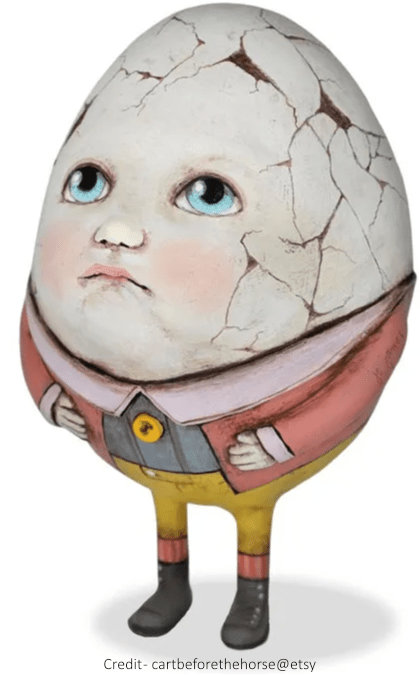
Let’s take a look at Humpty Dumpty.

“Humpty Dumpty sat on a wall,”

BY MOTHER GOOSE

Humpty Dumpty sat on a wall,

Humpty Dumpty had a great fall;

All the king’s horses and all the king’s men

Couldn’t put Humpty together again.

If all the king’s horses and all the king’s men couldn’t put Humpty together again, what can Humpty do for himself?

Consider the king’s horses and all their king’s men as my healthcare team. There is an abundance of specialists that are willing to help and guide me. Along that line, there is even the neuroplasticity where the brain can recover and repair from brain damage over time. Still, that’s not enough to heal. Humpty Dumpty and I have a responsibility to heal ourselves by learning how to adapt with what is given through discipline, practices, kindness, and love within life.

However, life is chaos. Chaos is terrifying. Chaos is exhilarating. Chaos is horror and beauty and everything between. How does one organize their own confusion through chaos?

I give room to learn through curiosity and wonder. What can I find within me and around me? What can I do? How can I add to it? The work is daunting, strenuous, and exhausting from the habitual exposures and practices by embracing all of life once again.

Two years ago, I brought in a dog to rescue, Gambit. Gambit was a pit bull mix around ten months and riddled with fear. He was incredibly sweet but would not walk on a leash; he immediately dropped to the floor. And I had an enormous fear as to whether I could handle him and give him what he’d need. We learned and adapted together. I could see his fear in him which helped me to build my own confidence.

Then there was the confusion. I worried whether I would confuse him by saying the wrong command. And what I learned is that he was more responsive with my gestures. Eventually, we were on the walks together where I started practicing my own speech therapy by trying to chit-chat along the way. He also encouraged me to maintain healthy routines and habits. He absolutely loves exploring the yard, his walks, and socializing with other dogs.

I kept adding more by surprising myself: long walks and trails, socializing at the dog park, learning the guitar, building friendships, going to concerts and theaters, and learning to write again.

We must give ourselves grace, kindness, and patience while healing; whether that’s mental, emotional, physical, spiritual, or all of the above. And we can find room to surprise ourselves by embracing life fully through love despite confusion.

Who knows what is ahead? How frightening. How sublime. How boring.

Take this single moment. Hold it. Then let it go. Life offers everything and nothing and everything in between. Practice finding love in unexpected places where confusion will not hold you back from life. Be you, fully, and life will be there for you.

Who would I be without my oligodendroglioma?

Although I cannot let my disease define who I am, I must acknowledge how the disease becomes intertwined with my identity.

My brain cancer slowly grows and invades surrounding healthy tissues. The healthy tissues protect and bind nerve cells like glue by supporting a flow of electrical signals in the brain, and the glioma cells can clump and form a tumor. I know have two tumors: one located in my left parietal lobe which has impact my language center, and the second is in my corpus callosum which could impact the coordination between the two hemispheres.

To extend my life, I’ve endured several treatments and surgeries to remove and kill the malignant tumors. The aggressive treatments like radiation have caused chronic illnesses such as necrosis, nerve pain, chronic headaches and fatigue. During a past neuro-oncologist visit that sticks with me, we had a conversation about how radiation can age the healthy cells and slow the process of forming thoughts and comprehension.

Since I’ve had two radiation treatments in the same region within four years and along with the brain hemorrhage, I can feel like a much older human being from the neuro-fatigue. Sometimes, I imagine a traffic jam where vehicles are annoyingly honking out of frustration during construction or an accident: “pump the breaks and slow down; more time is needed to create a space for the traffic to flow.” Then how old I may feel can fluctuate considering I am young enough to recover which becomes a matter of pacing and patience. Eventually, I do have moments to feel rejuvenated once again.

Similarly, although my infusions (Avastin) to alleviate the swelling (edema) from the radiation injury has been effective, the treatment is not a permanent solution and has its own side effects: mostly additional fatigue along with body and joint aches. However, beforehand, there had to be a confirmation as to whether there are dead tissues becoming a nodule which can appear like a tumor or whether there is a recurrence with the true disease. For this, there is a perfusion MRI which measures the blood flow through tissues to determine which one to treat.

And fortunately, since my GammaTile operation back in 2021, the true disease has been stable in my left parietal lobe. I chose the aggressive approach with GammaTile because I had gotten sick from taking any chemotherapy treatment. The radiation has done its job; perhaps too well by overdoing it with the necrosis, but the risk gained more time to deter another chemotherapy treatment which are limited for me.

I’m currently on lomustine and procarbazine to stabilize my corpus callosum’s tumor. There are six cycles for each six weeks. I’m on cycle five and finished my lomustine last Monday. I’ll start two weeks of procarbazine on this coming Monday. And counting down, if all goes well, I might be able to complete the treatment in September.

The chemotherapy treatments can wreck my stomach, and with procarbazine, I also have to be mindful with tyramine because I can get hives if I consume too much (which I have; whoops). And there seems to be a cumulative properties for the chemo where this last lomustine hit me hard with the nausea and fatigue. Still, I managed to recover well enough to enjoy spending time with family throughout the week and weekend: Top Golf, walks and meals, and even enjoying an outside concert. This is where life continues to surprise me when I’m willing to surrender myself into all of life which is a practice in itself.

There are these paradoxes that I often need to address during recovery and healing. The logical part of me wants to jump into the treatment planning: “Tell me what I gotta do against the disease; I’ll do it. I want to live, after all.” Then there’s the emotional component where I can feel like I’m drowning in despair: “How can I move forward when everything feels miserably overwhelming?” And this is when the logic becomes illogical yet still seems reasonable: “I’ve harmed myself once again” or “I feel like I’m dying.” Or in other words, I can get lost in the grieving through existential crises or dread: “I cannot keep doing this to myself. There is too much pain.”

One approach is grounding myself into quality of life. Again, there is the disease, and there are the chronic illnesses. For me, I need to transition further towards giving more healing for the chronic illnesses. There is only so much that my body, mind, and soul can take until I break. The challenging part is bridging the three by building habitual behaviors by leading towards a sense of wholeness. We have this capability by training our self-awareness through practices that connect between our inner and outer worlds with rituals and routines. By that, giving space and time to reflect on oneself like journaling, then interacting outside intentionally which creates impacts for oneself and others like enjoying a concert.

Or what people often say, “Gotta take it day by day.” And the complicated part is: “what do you do about your day? And how are days leading you? How do you feel overall?”

This is where I’ll bring in, “everything happens for a reason.” It’s another platitude.

Perhaps checking in, emotionally, “how do you feel when someone gives you a platitude?” It’s a moment to self-reflect and ease into one’s self-awareness. “There’s no fucking reason for anyone to be given a brain tumor.” Which is a moment to deconstruct a platitude and introspect: “where is your anger right now?”

Because fuck this disease. However, there are emotional reasons, and there are logical reasons. And we do not have access to all reasons. I will never know the reason for my brain cancer. We can name it: “I have an anaplastic oligodendroglioma.” But we do not understand what causes it yet. However, we can give reasons from what we do know: “Living with brain cancer has shaped my identity.”

By that, “everything happens for a reason,” then gives a feeling of “surrendering into the unknown.” Perhaps I’ll learn in time or maybe I never will. The importance is acknowledging the meaning as we are meaning and patter seeking species.

This is where it gets especially tricky when conversation: tone. Again, that can impact what we’re feeling in the moment from a platitude. Is someone giving an impression to come in closer? Or are they brushing something off because they’d rather not get closer? Therefore, it’s a moment to check-in and ask oneself, “how am I feeling right now when someone has given me this platitude?”

With that in mind, for me at least, I’ve been dipping deeper into soul work: “giving into the suffering for a certain amount of time.” That way, creating and giving space to allow myself to feel everything for a period of time which is in the inner world. Afterwards, getting back to the outer world by perhaps simply being outside and listening to the birds.

Because when I do reflect from how far I’ve grown from this disease and the chronic illnesses, I find that my resilience comes through as strength and connects through others. Both have shaped me as to who I’ve become now. And the more that I work towards this, the more I can give myself back to the world.

This feeling of softness internally where others seem to feel more comfortable with me and sharing their plights by remaining open with the heaviness and still feeling light. That while the disease comes across shocking and horrific, there is something beautiful in how we strive forward despite it all. This is beyond brain cancer or any disease. It’s a reminder that we’re still somehow able to live how we are for the time that’s given.

Who would I be without my oligodendroglioma?

I wouldn’t be me. All of this has pushed me to limits that I never would had expected, and I continue to be challenged. Sometimes it’s a matter of how to direct this energy with a sense of purpose by aligning intentions and impacts. And look at how many people are impacted by this disease and similarly strive forward to fight against the disease: researchers, non-profits, fundraisers, and so much more. This community continues to impress me, especially the fellow survivors and care partners who learn how to adapt with life.

Although I do not believe that there will be a cure in my lifetime, I do know that there are promising treatments towards stalling the growth while continuing to better understand the disease: inhibiters for gliomas seem promising with minimal risks.

There is hope even if we cannot find it. Hope is always there. It can be a matter of finding the willingness to dip deeper into the heaviness, learning how to endure, and finding the hope from a different perspective. I do not have hope for a cure. I have hope to truly feel alive like the air around me and to feel grounded once again in life; no matter what happens.

Recovering From Death

Let’s touch on death. Or at least, maybe death within life? I’m one who tends to seek meaning and metaphors in life.

With death, metaphorically, I imagine a snake shedding its skin: change. Literally, human beings also shed their skin’s dead cells. Connecting both, we must embrace change lest we become stagnant, or worse, rotten.

Change is painful. We hold onto parts of ourselves that we believe we need. We do it automatically. If you’re well, you never have to think about it. However, if you’re in a shock or coping from trauma, there are mechanisms in play to protect oneself which create barriers for growth. One has to be willing for change to happen and given support from others, especially professionals.

For me, I was close to death when I had my brain hemorrhage. For about a month, I felt like all this weight had been lifted from me with a feeling of bliss. Then my headaches had gotten extremely worse where I needed to be on steroids on and off. All the heaviness was back and worse. I had to grapple those swings, and I still can have that struggle during treatments.

For the swings, I imagine and ask, “where is my pendulum?” Am I swinging high, or am I swinging low? This involves my own energy output, but also how I can get affected from the treatments. Keeping the idea, I want to keep the momentum; otherwise, I feel stuck. I have to move with the swings but to make sure that I’m mindful with my choices and the consequences. Which can be absolutely exhausting. However, I have to make sure that I am pacing myself. “It’s a marathon, not a sprint.”

Yeah, well, I like to sprint sometimes. Again, that’s the choice and the consequence. It’s worth it sometimes.

A major impact from the acquired injury is that I cannot read well. An attempt to read exhausts my energy and brings in the headaches. To adapt, I’ve learned how to build connections with text-to-speech applications. Strange at first for free ones that feel robotic, but over time, my ideas can flow through me more easily. I’m also given more control by the speed of speech and can repeat until I understand the meaning. Along with that, I can struggle getting to my word: tip at the brain. I often can’t type it out correctly even if I can say it out loud.

My main tools are enabling dictation on my iPhone, NaturalReader, a notes app, and Google. That way, I can now read any text by speaking it out to me, or I can speak out any text if I’m struggling to type it out. And if I’m really struggling to get the word, Google has the best search results for what I’ve intended.

I’m doing these apps now while writing this blog post. On my own, I don’t know how long it would take. I could get there. Eventually. But how could I live like that? I’d be on a much higher difficulty to live and communicate socially. That’s the power of technology. There is a lot of assistance that’s available from any impact to the brain. For me, it’s been a matter of the commitment with the swings.

Similarly, my brain needs exposure in dynamic environments while being aware of how I can struggle with overstimulation and oversensitivity. For the first couple years, I would be easily overstimulated and would have to lie down in a quiet place for a long nap. Through exposure overtime and adding assistance with a earplug to dampen and filter the noise, I’ve found myself opening up more to social environments.

Today, I was able to walk my dog, Gambit, to the dog park with some chitchats, then I enjoyed a movie at the theater. And I’m still somehow writing this blog post. Stopping for a moment checking in on my progress over the years, I’ve made leaps and bounds. The brain is fragile, but more importantly, it’s resilient. Bringing back the pendulums, perhaps imagine the swings like swing set. Something more playful sometimes.

All that to say, the losses are the deaths where we can give room for more growth. We have to ease into the losses and feel them, truthfully. That’s the grief. And through the grief, we create spaces to regenerate one’s self through the healing. And we don’t need to do it alone. We grow together.

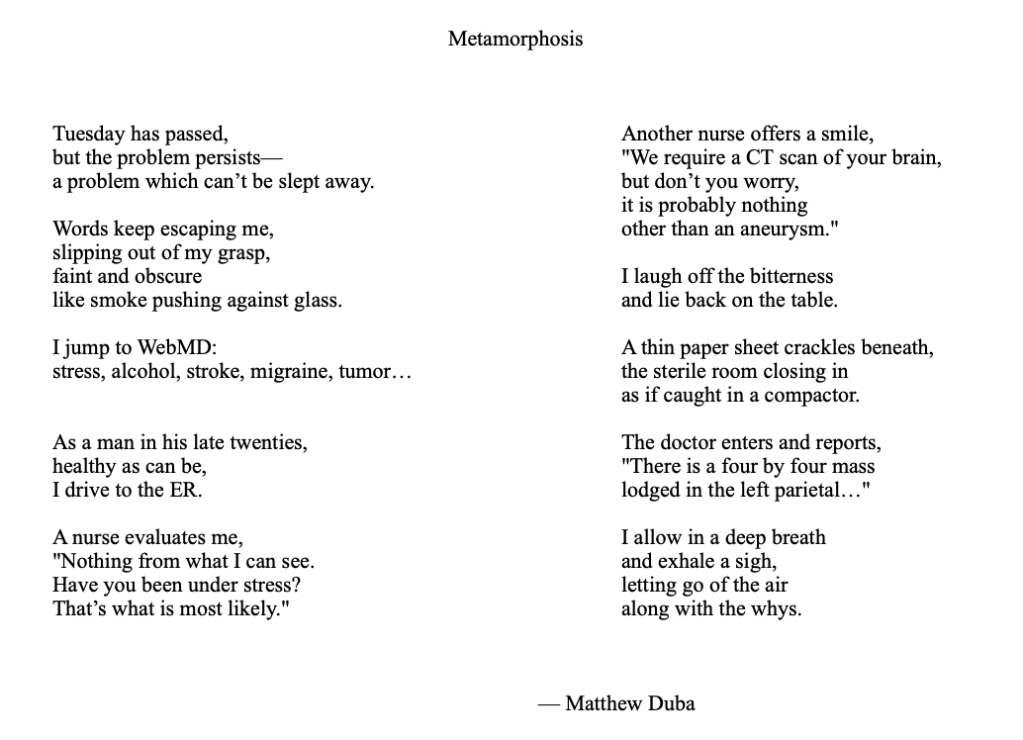
Sharing a little more, this is a poem that I wrote during a creative writing class right before the pandemic and my brain hemorrhage.

An attempt to open up with my imagination and creativity can be incredibly painful. I lost my sense of imagination after the brain injury. I didn’t know if I’d ever get a sense of creativity back. However, that’s also going well with the recovery where it’s becoming more cathartic to push forward. I’m trying right now. Here’s a draft for fiction:

“The Boy Who Would”

Chapter One

Lost

Once upon a time, a boy fell in love with the sky. He quickly learned how to fly and touch the clouds.

In time, he became compelled to fly beyond the sky to escape his worries. He flew too high and too fast. He blacked out, spinning and falling into an abyss. When he woke, there was nothing for him but darkness; there was no light in sight. He crawled into a ball and cried until he could not.

A whisper of a breeze broke his slumber with a drip. He stood up, dizzy and foggy. He took one step forward, then another drip, drip. He followed the droplets, then lifted his hand to brush his fingers across the mist nearby.

There was an echo from another drip, drip, drip. Step by step, he was led to a stone wall. He ran the tips of his fingers along a curved statue. A warmth shined into his heart, quivering his bones.

He opened his eyes and the warmth dissipated. Ominous shadows lurked around him. He squeezed his eyes closed and clenched his teeth. He open palmed his hands against the marble, screaming out, “I’m not afraid.”

A strange voice bellowed, “You should be.”

“W-w-who are you?”

“More importantly, who are you?”

“I… I don’t remember.”

“That happens here.”

“Where am I?”

“Everywhere, nowhere, and in between.”

“I don’t understand.”

“You will.”

“I want to get back home.”

Silence. He crawled into a ball and cried and cried until he could not.

A step in a new direction

I have recently had a follow-up MRI alongside consultations with the medical oncology team, then later met with the radiation oncologist.

The good news: the MRI showed that the tumor is stable.

The ambiguous news: the medical oncology team advised that I continue with another six cycles of chemotherapy.

Typically, I would have been given an option to take a break after completing the twelve cycles or continue with another six cycles. Due to the growth in the last scan, there was concern for ensuring that the tumor is kept stable which would require continuing the chemotherapy for another six cycles.

Where the ambiguity comes in is that the radiation oncologist had a difference of opinion and believes that now is a good time for radiation. The medical oncology team warned me before the consultation.

Warning: the radiation oncologist will be radiation happy.

Their excitement about the potential for the specialized treatment can come across as overzealous.

Warning: the radiation oncologist will have rose colored glasses about the side effects.

Patients who receive radiation will follow up with the medical oncology team and have reported side effects that will not be communicated back to the radiation oncologist. Long-term side effects such as memory problems, fatigue, and other potential issues caused from damage to healthy tissue.

Warning: radiation is generally a one-time treatment option.

The damage to the tissue is too severe to expect multiple radiation treatments in the future.

That said, there are other ways to look at the warnings:

Both teams will be presenting advisement based on their specialty. The medical oncology team specializes with the chemotherapy, and the radiation oncology team specializes with the radiation.The chemotherapy is an attempt to keep the tumor stable, and the radiation is a more definitive treatment to stop the growth by killing off as many of the malignant cells as possible. Both need to be evaluated to determine which is most applicable for the uniqueness of my case.

While this is concerning, the information is rather vague and incomplete. As important as it is to acknowledge the potential side effects, it is important to consider how the side effects can be managed and improved.

Similarly, as concerning as the one-time treatment is, the timing may be right. If there is a recurrence in the future, it will become a new case and will have to be handled differently. Although the radiation is generally advised as a one-time treatment option, there could be a case where light radiation could be used in the future if necessary.

On the other side, I have concerns with continuing the chemotherapy considering the tumor has demonstrated growth twice: once on a break and another while taking 1500mg of chemotherapy a week every four weeks over the course of ten cycles. Although the dosage was bumped up to 2000mg a week for the last two cycles and kept the tumor stable, the question becomes what will happen in another six cycles.

The best case scenario would be that the tumor remains stable. Then what? The last break lasted a year. Based on the progression of the tumor over the years, I think it would be optimistic to expect the tumor to remain stable for more than a year while on a break. The other option might be to continue the chemotherapy, but if that were the case, I do not know how well my body would be able to handle the high dosage indefinitely. In either case, we would be waiting for a growth to become visible on the MRI. At that point, the tumor will have grown larger and effectively creating a large volume that would need to be targeted for the radiation therapy.

Either continuing the chemotherapy or going through with the radiation treatment would be reasonable choices which leaves it up to me.

I have decided on moving forward with the radiation treatment as I believe now is the right time for me. Rather than waiting to have my hand forced by what feels like an inevitable growth of the tumor in the near future, I am making the decision to attack the tumor now while my body, mind, and spirit feel prepared to withstand the treatment. Six months ago, I am not sure if I would have been able to make this decision. I may have decided to wait. The decision weighed heavy and has taken time with reflection, but I believe I am making the best decision. I feel confident moving forward.

Intensity-modulated radiation therapy (IMRT) will be used to irradiate the tumor. This is an advanced technique that is highly precise in targeting the malignant tumor and minimizing any damage to normal tissue. A CT scan of my brain will be fused with an MRI scan to create a three-dimensional model of my tumor, and a physicist along with the radiosurgery specialist will work with the calculations over a week to prepare for the treatment. The radiation dosages will then be delivered by computer-controlled linear accelerators.

The plan is to start my treatment on 8/28 at UT Southwestern, and it will last six weeks. During that time, I will be taking a low dose of chemotherapy each day to make the tumor radiosensitive. The radiation treatments will be five times per week and receiving the dosage will feel like an X-ray. The side effects from both the radiation and chemotherapy are not expected to hit me until the last couple weeks, and what is typically reported is fatigue as if crashing into a brick wall.

I feel as if I have been preparing for this. As scary as it is, this is a treatment option that has the potential for adding years to my life. The hardest part will be working through the side effects and how those side effects can attempt to define my identity. I plan on continuing my routine which includes but is not limited to: whole, natural foods with minimal animal products, mindful meditation, yoga, cold exposure, and self-compassion. Each step of the way will present a new challenge, but such is life. I feel ready, and while it may sound strange, there comes a slight excitement and hope along with it. Hope that whatever happens, I can work through it, and even if there are times where I fall off path, I can find my way back.

To the readers, I would appreciate any thoughts or prayers that are directed at the success of the radiation treatment. Although the goal is to stop the growth, I am directing my energy towards the possibility that we can take it one step further and kill all the malignant cells, potentially shrinking or eliminating the tumor. For my case, the possibility seems like a shot in the dark, but in this instance, a shot in the dark is better than no shot at all.

Finally, any thoughts or prayers for Lauren and my family would be appreciated as well. While I am the one going through this treatment, they will be the ones who are providing support, forced to walk their own paths alongside me and confront their own challenges along the way.

The start of a new journey

Well, here I am! My first venture into the public blogland.

I have decided to create a blog in order to log my journey of battling cancer, to share tidbits of information that I am learning along the way, and to probe and explore a variety of topics that I personally find meaningful.

Although cancer isn’t an easy topic to tread, I have come to accept that it is part of the chaos that is life and worth discussing and exploring. The scariness can be softened through coming to understand what it is and how to manage it.

At the most simplistic level, cancer is just an uncontrolled division of abnormal cells. I have anaplastic oligodendroglioma which is a type of glioma that is believed to originate from the oliogdendrocytes of the brain or from a glial precursor cell. Mine happens to be located in the front back left parietal lobe which is actually how it was discovered. There are two known parts of the cerebral cortex that is linked to speech, and my tumor affected what is called Broca’s area.

EDIT: I would like to clarify that the tumor is actually in the back, not the front. I’ve known this but made a mistake when referencing Broca’s area. Although Broca’s area is typically in the front, my case has gone against the textbook. Interestingly, it’s an example of how unique we are as individuals and how difficult of a task it can be for the medical team to map out a brain and discover and work with areas that go against the norm.

In January of 2014, expressive aphasia took me by surprise while having a meeting with a coworker. The words coming out of my mouth weren’t aligning with my intent, and there were words left out which made it difficult to understand my meaning. Initially, I thought it was a fluke and tried to write an email instead. Perhaps, I was just having an off day. While working on the email, I quickly and frustratingly realized that it wasn’t a fluke. I couldn’t even make sense of the email. After several attempts with revisions, I gave up on the email and took the day off.

What could possibly have been happening, I wondered? I wasn’t having any headaches. I wasn’t showing any other symptoms. Maybe stress was getting to me. I was reminded of the WebMD memes.

I didn’t allow myself to overreact. I expected it to just go away. When it didn’t go away, I called around to see if I can consult with a doctor. A nurse ended up telling me that I needed to go to the ER to have a scan.

I showed up at the ER with my parents, and my speech didn’t seem abnormal. The nurse taking my vitals didn’t think anything was wrong. Later on, another nurse threw out a joke before the CT scan that it’ll just take a couple hours, then they’ll send me home with a brain aneurysm. Needless to say, she had to choke on her words when the 4x4cm tumor showed up on the scan.

Since then, I have had an awake craniotomy to remove majority of the tumor. The tumor was graded between II and III which gave me the option to either do twelve rounds of chemotherapy with radiation, or just the chemo. I opted out of the radiation due to how it is generally recommended for my case as a once-in-a-lifetime treatment. The damage from the radiation would warrant too much risk to expect multiple treatments over a lifetime barring exceptional circumstances; therefore, the treatment would only be recommended if seen as necessary which was not the case at the time.

Due to the blood-brain barrier, I have to take a pill form of chemo in order to sneak through the barrier to attack the cancerous cells. It is important to keep in mind that the goal of chemo is to stabilize the tumor and defer growth. If the chemo were to reduce or shrink the tumor, that would be awesome, but the intention is to simply keep it from growing to hold off for a different treatment in the future.

After the first year of chemo, I opted to take a break for my quality of life. During that time, I had regular MRI scans to monitor the tumor.

A year and half later, there was a growth. Getting on chemotherapy again actually reduced the tumor back to where it was post-surgery which was great news. This time, however, I have completed twelve rounds of chemotherapy, and there has been another growth at some point after the tenth round.

The concern now is that I may require radiation in order to target and eliminate as many of the cancerous cells as possible. With these last couple rounds, I have increased the dosage, and on August 9th, I will be having another MRI scan, followed up with consultations with my oncologist and a radiosurgery specialist in order to make a decision on what the next steps will be.

I will be using this blog to log the journey, and in the meantime, all thoughts and prayers are appreciated, especially coming up on August 9th when we will be checking the status of the tumor and evaluating the best course of action.