Let’s touch on death. Or at least, maybe death within life? I’m one who tends to seek meaning and metaphors in life.
With death, metaphorically, I imagine a snake shedding its skin: change. Literally, human beings also shed their skin’s dead cells. Connecting both, we must embrace change lest we become stagnant, or worse, rotten.
Change is painful. We hold onto parts of ourselves that we believe we need. We do it automatically. If you’re well, you never have to think about it. However, if you’re in a shock or coping from trauma, there are mechanisms in play to protect oneself which create barriers for growth. One has to be willing for change to happen and given support from others, especially professionals.
For me, I was close to death when I had my brain hemorrhage. For about a month, I felt like all this weight had been lifted from me with a feeling of bliss. Then my headaches had gotten extremely worse where I needed to be on steroids on and off. All the heaviness was back and worse. I had to grapple those swings, and I still can have that struggle during treatments.
For the swings, I imagine and ask, “where is my pendulum?” Am I swinging high, or am I swinging low? This involves my own energy output, but also how I can get affected from the treatments. Keeping the idea, I want to keep the momentum; otherwise, I feel stuck. I have to move with the swings but to make sure that I’m mindful with my choices and the consequences. Which can be absolutely exhausting. However, I have to make sure that I am pacing myself. “It’s a marathon, not a sprint.”
Yeah, well, I like to sprint sometimes. Again, that’s the choice and the consequence. It’s worth it sometimes.
A major impact from the acquired injury is that I cannot read well. An attempt to read exhausts my energy and brings in the headaches. To adapt, I’ve learned how to build connections with text-to-speech applications. Strange at first for free ones that feel robotic, but over time, my ideas can flow through me more easily. I’m also given more control by the speed of speech and can repeat until I understand the meaning. Along with that, I can struggle getting to my word: tip at the brain. I often can’t type it out correctly even if I can say it out loud.
My main tools are enabling dictation on my iPhone, NaturalReader, a notes app, and Google. That way, I can now read any text by speaking it out to me, or I can speak out any text if I’m struggling to type it out. And if I’m really struggling to get the word, Google has the best search results for what I’ve intended.
I’m doing these apps now while writing this blog post. On my own, I don’t know how long it would take. I could get there. Eventually. But how could I live like that? I’d be on a much higher difficulty to live and communicate socially. That’s the power of technology. There is a lot of assistance that’s available from any impact to the brain. For me, it’s been a matter of the commitment with the swings.
Similarly, my brain needs exposure in dynamic environments while being aware of how I can struggle with overstimulation and oversensitivity. For the first couple years, I would be easily overstimulated and would have to lie down in a quiet place for a long nap. Through exposure overtime and adding assistance with a earplug to dampen and filter the noise, I’ve found myself opening up more to social environments.
Today, I was able to walk my dog, Gambit, to the dog park with some chitchats, then I enjoyed a movie at the theater. And I’m still somehow writing this blog post. Stopping for a moment checking in on my progress over the years, I’ve made leaps and bounds. The brain is fragile, but more importantly, it’s resilient. Bringing back the pendulums, perhaps imagine the swings like swing set. Something more playful sometimes.
All that to say, the losses are the deaths where we can give room for more growth. We have to ease into the losses and feel them, truthfully. That’s the grief. And through the grief, we create spaces to regenerate one’s self through the healing. And we don’t need to do it alone. We grow together.
Sharing a little more, this is a poem that I wrote during a creative writing class right before the pandemic and my brain hemorrhage.
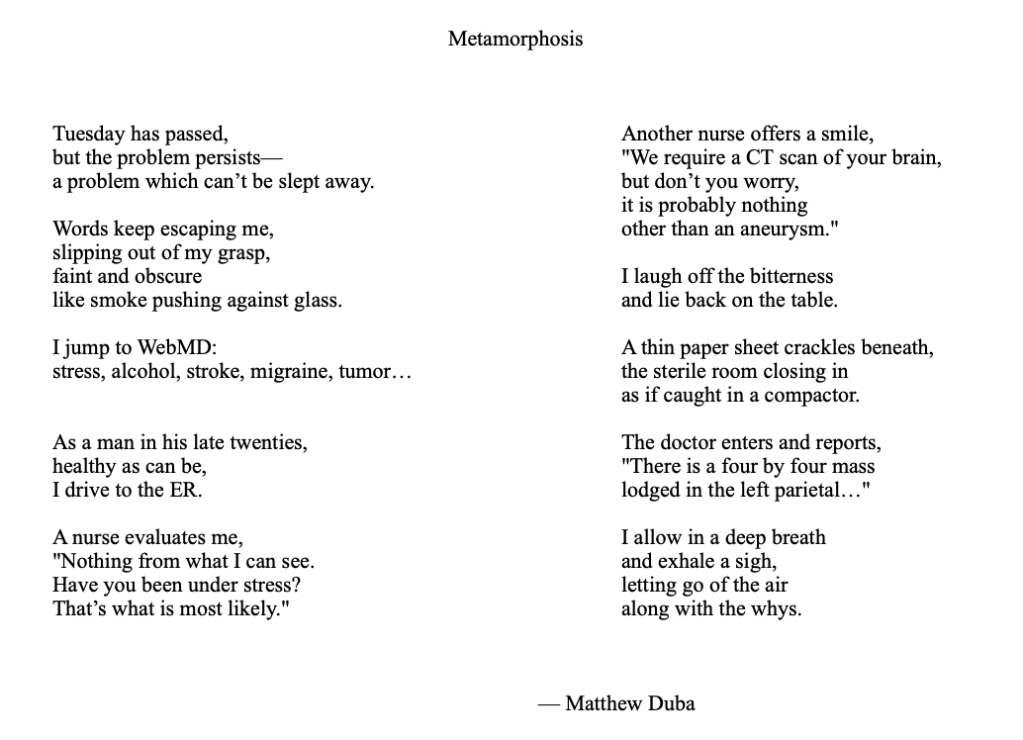
An attempt to open up with my imagination and creativity can be incredibly painful. I lost my sense of imagination after the brain injury. I didn’t know if I’d ever get a sense of creativity back. However, that’s also going well with the recovery where it’s becoming more cathartic to push forward. I’m trying right now. Here’s a draft for fiction:
“The Boy Who Would”
Chapter One
Lost
Once upon a time, a boy fell in love with the sky. He quickly learned how to fly and touch the clouds.
In time, he became compelled to fly beyond the sky to escape his worries. He flew too high and too fast. He blacked out, spinning and falling into an abyss. When he woke, there was nothing for him but darkness; there was no light in sight. He crawled into a ball and cried until he could not.
A whisper of a breeze broke his slumber with a drip. He stood up, dizzy and foggy. He took one step forward, then another drip, drip. He followed the droplets, then lifted his hand to brush his fingers across the mist nearby.
There was an echo from another drip, drip, drip. Step by step, he was led to a stone wall. He ran the tips of his fingers along a curved statue. A warmth shined into his heart, quivering his bones.
He opened his eyes and the warmth dissipated. Ominous shadows lurked around him. He squeezed his eyes closed and clenched his teeth. He open palmed his hands against the marble, screaming out, “I’m not afraid.”
A strange voice bellowed, “You should be.”
“W-w-who are you?”
“More importantly, who are you?”
“I… I don’t remember.”
“That happens here.”
“Where am I?”
“Everywhere, nowhere, and in between.”
“I don’t understand.”
“You will.”
“I want to get back home.”
Silence. He crawled into a ball and cried and cried until he could not.
 The Way of a Duba